

Hi there 👋 This is this year’s final edition, written as we head into a season that reminds us of the value of togetherness.
A Word That Stayed With Me
At the end of a Universal Design course a couple of years ago, I asked our design students to pick one word that best described Universal Design.
One of the students immediately answered: "Togetherness!", and their peers nodded in agreement. I was surprised by their swift reply and choice of this particular word, especially since I had never used that term when teaching.
Something in that shared silence told me they weren't just talking about design – they were describing a feeling.
That moment has stayed with me. Because discussions involving Universal Design often revolve around functions, features, or characteristics. But what about feelings and experiences? The students understood something profound: Universal Design isn't just about what works. It's about what it feels like to belong.
The Festive Season as Togetherness Made Tangible
There's a reason we gather at this time of year. The dark evenings, the shared meals, the rituals that bring people into the same room, around the same table. The festive season, at its best, is togetherness made tangible.
Not perfect togetherness – gatherings can be messy, awkward, sometimes exhausting. But there's something in the intention: we are here, together. You are anticipated and desired. A place is already waiting.
Togetherness here is not about everyone doing the same thing, celebrating the same holidays, or wanting the same kind of closeness. It is about beginning from the assumption that different ways of being present are equally legitimate.
Design can learn from this. Not togetherness as an ideal state, but togetherness as a starting point. A position, a feeling and a mindset rather than an achievement.
A Design Lens: "I Already Belong"
In the previous post, Say “I Already Belong” And The Conditional Access Paradigm Crumbles, I introduced the phrase "I already belong" as a paradigm shift – from conditional access to nonconditional belonging.
Since then, I've found myself using this as a lens. Every designed situation can be viewed through this question: Does this designed living environment say "You already belong" – or does it say "Do you want access"?
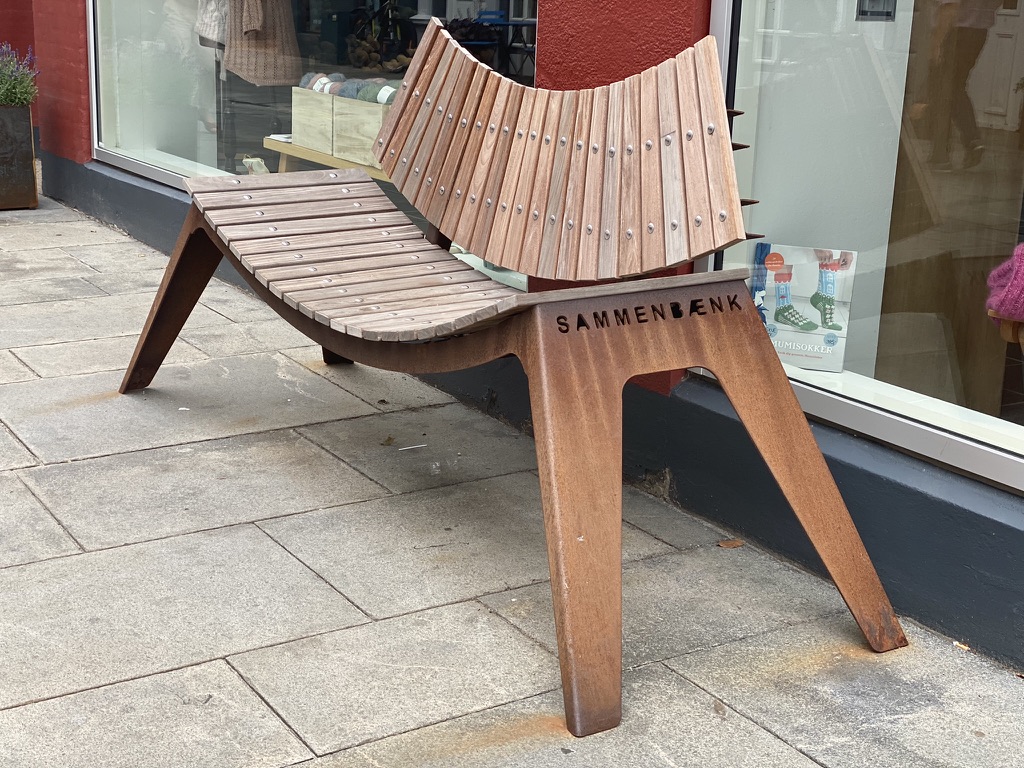
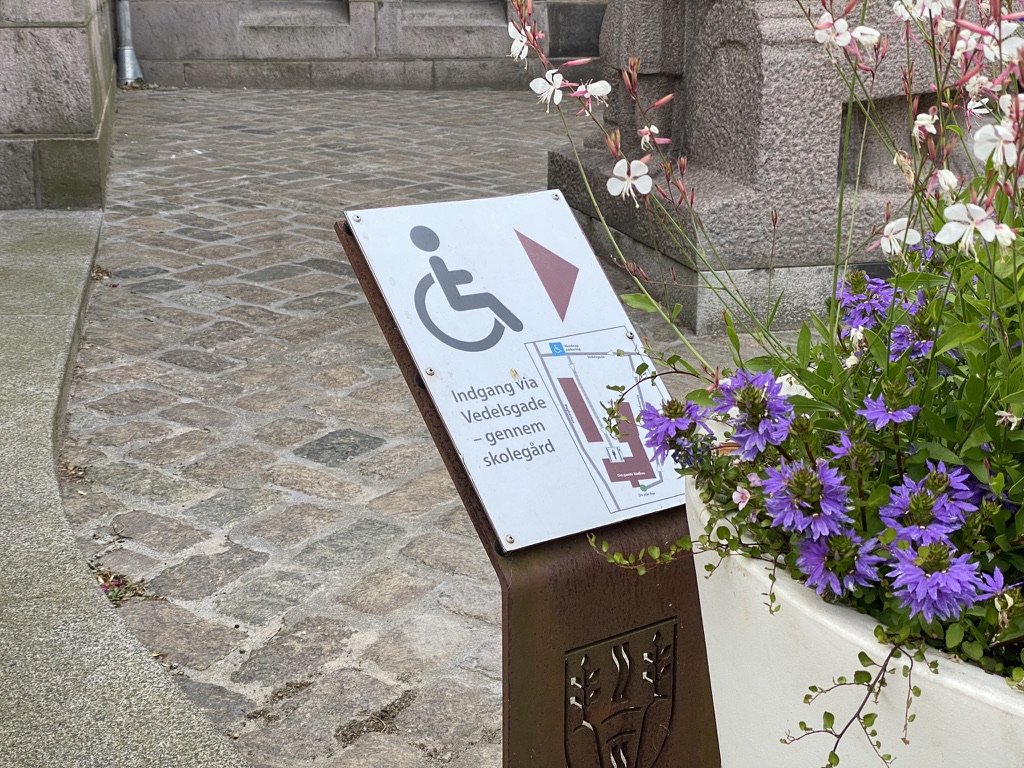
Left: A "Together bench". Right: A sign pointing towards a separate entrance through a school yard.
Consider the two images from Vejle, Denmark, above. To the left is a bench that slopes inwards in a curve, gently bringing people together. The bench is a comment. It gestures towards shared presence rather than separation: Sit down, you're already expected here, I embrace you. At the same time, my own experience from using a wheelchair complicates that message. Intention alone does not guarantee togetherness. But the spirit of the bench stands in stark contrast to the sign pointing towards a separate entrance through a school yard in the right photo.
One assumes presence. The other grants permission.
This is the difference between conditional and nonconditional togetherness. Try it yourself. Look at a space you use regularly and ask: Does this signal that I already belong here, or does it ask me to “access” it?
Difference is Something We All Share
The idea of an imagined “normal” person continues to shape much of how we design, often without anyone explicitly intending it. Throughout the years, many have tried to challenge it. Edward Steinfeld described human difference as "a condition that we all share." Todd Rose debunked the myth of the average human being. Margaret Mead said, "Always remember that you are absolutely unique. Just like everyone else."
Everyone is differently different. We are all already part of the variation. Design can acknowledge and celebrate this.
Design in Togetherness to Create Togetherness
Our students pointed towards something important: Togetherness isn't just a nice outcome – it's both method and goal.
When we design in togetherness, through genuine co-creation and refusing to sort people into categories of “us” and “them”, we create spaces that bring people together rather than sort them apart. This isn’t about being “friendly” or “welcoming” – it’s an ontological assumption about belonging.
Designing in togetherness yields designs that support togetherness.
This season, if and however you celebrate it, may your gatherings feel like that inward-leaning bench: a gentle force bringing you together, saying, you already belong.
Happy [this space intentionally left blank] 💚
Notes and References
This piece builds on findings from The Syntax of Equality project, where we investigate situation-based categorisation and nonclusive design through citizen science and field observations.
You can find all the previous editions of Nonclusive by Design on LinkedIn.
Do you want to use the photos or illustrations in a publication? Please go ahead. Or in a presentation or video? Please do, and tell me about how you use them and what you learn! I appreciate attribution in some form, i.e., that you tell where you got the material from ("Per-Olof Hedvall"), but it is not mandatory. 👍
References (free to download):
- Hedvall, P. O., & Ericsson, S. (2024). From Inclusive to Nonclusive Design – A Shift in Categorisation. In Difference – Sketching, Visualising and challenging Universal Design in Sweden (Vol. 19, pp. 10–30). Design for All Institute of India. http://designforall.in/?mdocs-file=2470.
- Hedvall, P.-O., Price, M., Keller, J., & Ericsson, S. (2022). Towards 3rd Generation Universal Design: Exploring Nonclusive Design. Transforming Our World through Universal Design for Human Development, 85–92. https://doi.org/10.3233/SHTI220824.
- Ericsson, S., & Hedvall, P. O. (2024). Situation, Non-categorisation, and Variation—Conveying Nonclusion Through Text and Image. In Difference – Sketching, Visualising and challenging Universal Design in Sweden (Vol. 19, pp. 31–50). Design for All Institute of India. http://designforall.in/?mdocs-file=2472.
- Johansson, S., Hedvall, P.-O., Larsdotter, M., Larsson, T. P., & Gustavsson, C. (2023). Co-Designing with Extreme Users: A Framework for User Participation in Design Processes. Scandinavian Journal of Disability Research, 25(1), 418–430. https://doi.org/10.16993/sjdr.952.


